Showing posts with label breast cancer. Show all posts

Saturday, March 12, 2011

In Qatar


It used to be that people wouldn't talk about cancer, especially breast cancer, and that women who noticed lumps would wait months and months and maybe years to get treatment. That's how it is in Qatar, according to a short video. Watch the film in a quiet place, because the volume is pretty low, at least it was on my computer.
READ MORE - In Qatar

Thursday, September 30, 2010

Safe way of detecting Breast Cancer

As you all must be already aware that October is recognized as the Breast Cancer Awareness Month. There has been a recent increase in the number of people suffering from this cancer. 
Worldwide, breast cancer comprises 10.4% of all cancer incidence among women, making it the most common type of non-skin cancer in women and the fifth most common cause of cancer death. In 2004, breast cancer caused 519,000 deaths worldwide (7% of cancer deaths; almost 1% of all deaths). - Wikipedia
Thus, it is very important for every woman and even males to be aware of their susceptibility to breast cancer. An earlier diagnosis is always helpful for timely treatment. Thus, comes the need for screening. Screening is the term used for testing healthy women and men for achieving earlier diagnosis. There are many screening tests - self examination, mammography, genetic screening, ultrasound and magnetic resonance.

A self-examination is most critical of all and should be done regularly to make sure there are no lumps in the breasts. You can do this in the privacy of your home. Start with one breast. Lift the corresponding hand up and feel your breast with the other hand. This method is called palpitation meaning feeling the firmness of the object. While examining this way feel for the presence of any lumps or soreness. Cover your complete breast while standing and while lying down and other positions as shown in the picture including the nipple region and the skin around and under your breasts. This can be done in various ways like vertically drawing straight lines on your breasts with your fingers, moving outward starting from the nipples or moving in concentric circles starting form the nipples. Repeat the procedure with the other breast. In case of any confusion, immediately seek doctor's advice. (Note: The picture is not to offend anyone's senses but to impart awareness.)

Mammography is another screening test. Unfortunately, in this technique, your body is exposed to low dose X-rays for proper diagnosis of the disease. And, a repeated exposure to radiations, however, low is a potential risk associated with this diagnosis technique. And, then, there are added risks of false positives and false negatives where you might be detected for breast cancer when you are not suffering from the disease and you might not be detected for breast cancer when you are suffering. This is, often, due to the density of tissues present in the breasts. Thus, many people would like to avoid this technique of detection. Here is an account of Mammogram experience of Sesame from Vivawoman.

Thus, there are recent advances and a new diagnosis technique for any disease has come into picture -
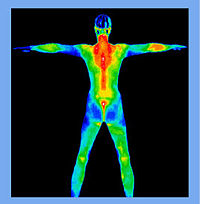
Digital Infrared Thermal Imaging (DITI). In this technique, images of the body are taken (called thermograms) and sent to medical practitioners for interpretation of the images and diagnosis results. Thus, you are not subjected to any radiation, however, small. It is being used for small clinical uses and among them the foremost usage is for early breast cancer detection. And, in this, the physical images of your body are not taken. To explain what kind of images are taken, I would need to delve deeper into the technique. Our body emits infrared radiation which is highly symmetric to the parts of our body as shown in the picture. So, a special camera is used to capture this radiation being emitted from the body and corresponding skin surface temperature and displayed on a screen where the amount of radiation being emitted is shown in various colors. Any change in the radiation or temperature is, thus, detected by the change in color. This is just a gist of how this technique works. The benefit of this technique is that it can detect early lesions but the drawback is that it is not widely available. I would encourage you to read this article which shares the experience of lady who went for DITI.

A note to my readers: If anyone has gone through any such tests and experiences, I would kindly request you to share your experiences. If you would like to publish an account (even anonymously), please feel free to mail at perfectskincareforyou@gmail.com. Awareness can prevent breast cancers. And, do not forget to force your women above 40 for a breast cancer screening. It can be a life saver.
READ MORE - Safe way of detecting Breast Cancer

Sunday, August 1, 2010

Leah Siegel


I usually don't have two deaths in a row, but this was just published today, and sent to me by a good friend of Leah's. She was diagnosed with Stage 4 breast cancer right after she had her third child. This piece even cut into the stony old heart of Cancer Bitch.
READ MORE - Leah Siegel

Tuesday, May 4, 2010

Lynn Redgrave, 1943-2010


Lynn Redgrave has died of metastatic breast cancer. The photo on the left is by her daughter Annabel Clark, August 2003, after surgery, chemo and radiation.
Here's a link to a post from Ms. magazine blog, which includes a list of her films.

She wrote a book about her cancer experience, which was published with her daughter's photos. In 2005 they were interviwed by CNN's Paula Zahn:

ZAHN: You were much more troubled by losing your hair than your breast?

REDGRAVE: I really was. I think if I'd been younger, the breast would have been more of an issue. It is still strange to only have one. I didn't have reconstruction. One of them is one of those wonderful prosthetics. I've gotten used to that.

While going through chemo, she never missed a performance.

[Photo below of Redgrave by daughter Annabel Clark after surgery, with drains, January 2003]
READ MORE - Lynn Redgrave, 1943-2010

Friday, October 30, 2009

Horrors! Woman touches own breasts on TV!


{Sorry--I couldn't figure out technically how to capture a still of the woman examining her breasts. It is much less sexy than this stock picture from photosearch.com. }

It took a while, but I finally found the un-blurred video from the ABC News local WJLA in Washington, DC., which showed--horrors!--a pretty 28-year-old woman with cancer (before surgery) examining her small, perky breasts. Reporter Gail Pennybacker, thank goodness, warns us beforehand that "Images are going to be graphic." Gosh!! Nipples!! Nipples, which are obscene, are going to be shown. Lock up your women and children! Your children will be traumatized by seeing nipples! Of course, they are not affected by daily, hourly images of war and mutilation--or "action" movies and videos.
The news station brought this all on itself by happening to air this during sweeps week, when viewership is measured. If WJLA wanted to be as blameless as Caesar's wife, it would have run this earlier in the month.
Meanwhile, conservative groups have criticized this display. The AP tells us: The Parents Television Council reacted cautiously to news of the series but suggested it saw the potential for problems.

"We hope that WJLA-TV is not using a crucial public health issue as a ratings stunt, and that the station has fully considered what is appropriate to tell this important story to the public in the most suitable manner possible," the group said in a statement. That might mean different versions of the story at 5 p.m. and at 11 p.m., it added.


I wish the reaction were more outlandish so I could make fun of it. It's also annoying that that first thing that pops up on the PTC web site is a study that says that images of violence against women are on the increase on TV. Really, how can anyone find fault with an organization that cares about violence against women (at least representations of it)? If you read further, you find the organization is Mrs. Grundy-ish (Does anyone say "Mrs. Grundy" any more?) about "indecency" and cursing and sex on TV. Yeah, a lot on TV boils down to immature sniggling about sex, but that's not my most pressing issue.

It's easier to make fun of another critic, Concerned Women for America, which strives "to protect and promote Biblical values among all citizens - first through prayer, then education, and finally by influencing our society - thereby reversing the decline in moral values in our nation." But reading about them makes me more scared than sarcastic. Separation of Church and State, anyone?


[Mrs. Grundy by Walter Crane, 19c]


[not to be confused with Miss Grundy of Archie Comics, pictured at top]


Breast cancer is one thing I do think about a bit. And I was and am lax on breast self-exams. Mostly, the hoopla about the news report is serving to remind me that I need to examine my right breast, that I shouldn't just rely on the six-month mammograms and doctor exams. So ladies, go to it! See instructions and illustrations at this site.

Click here for visuals that are really adult and graphic and for which our country is to blame.

"Murder is a crime; describing murder is not. Sex is not a crime. Describing sex is. Why?" Gershon Legman wrote years ago. I know, I know, this weakens all of the above, because my implied argument is that showing a breast exam is not a smutty, sexual event, but it seemed apropos.
READ MORE - Horrors! Woman touches own breasts on TV!

Friday, August 8, 2008

Breast Cancer Comics


The New York Times recently reviewed the graphic novel "The Bottomless Belly Button," by Dash Shaw. An astonishing 720 pages, the story follows an extended family as they react to the news that the grandparents are getting a divorce. There's a lot of buzz around "The Bottomless Belly Button;" New York magazine called it the "graphic novel of the year." And, there's just as much interest in the author and artist, 25 year-old Dash Shaw. For such youth, he's prolific, having already inked critically acclaimed "The Mother's Mouth," and several shorter works.

When I Googled him, I was surprised to see his name attached to a search result for "Breast Cancer Comics," from the web site MyBreastCancerNetwork.com. Readers submit their stories, and Shaw (who looks about fourteen in his profile photo) interprets them in graphic form. Perhaps it was a good gig for a starving artist. I somehow have the feeling he's about to become too famous for this kind of work.

"A Week at the Beach, With a Divorce Imminent" Book of the Times. [Link]

Breast Cancer Comics [Link]

Dash Shaw's website [Link]


Posted by The Fifty Foot Blogger
READ MORE - Breast Cancer Comics

Thursday, July 5, 2007

Cancer: Light & Dark

I'm trying to make sense out of two articles about the effect of artificial light at night on breast cancer rates. My friend C sent me a recent piece about this from the Chronicle of Higher Education; I'll post the article as a Comment. A better piece was in Science News. In short, the researchers say that in order to reduce your risk of breast and possibly prostate cancer:
-Sleep in a dark room and at night. More than nine hours is better than less.
-Stay away from foods with linoleic acid--which is rife in processed foods that contain corn syrup, corn oil, safflower oil and cottonseed oil. Linoleic acid helps tumors grow.
-Don't work the night shift. And if you do, don't raid the vending machines with your workmates because a lot of the packaged food in there is laden with linoleic.

Except. It's not that simple.

But first, the main idea: "'Breast tumors are awake during the day, and melatonin puts them to sleep at night," according to researcher David E. Blask, quoted in Science News. Another scientist says that you don't have to be asleep for optimum melatonin production, but you have to be in a dark room. From Science News: "Melatonin forms in the pineal gland, located in the brain, and circulates in the bloodstream. Blood concentrations of the hormone rise after dark from low daytime values and usually peak in the middle of the night." Studies have shown that women who work at night are more likely to have breast cancer, hypothetically because their melatonin levels are suppressed by light at night. In addition, a Finnish study showed that women who slept more than 9 hours a night were less likely to get breast cancer. And blind women have been shown to have less breast cancer than other women, and a "high average" level of melatonin.

Melatonin also keeps cancer cells from absorbing linoleic acid, which promotes cancer growth.
So, the experts say to sleep in a dark room. Blask does this himself and also takes melatonin supplements. Another researcher cautions people about taking melatonin because it's not regulated. But as a letter writer to Science News asked: "Are you really going to tell me you aren't going to take melatonin--if you're convinced that it might lower your chances of getting cancer by as much as 50 percent--because you are afraid of impurities?"

It seems that you could trade day for night, and get your melatonin from a dark room at midday. But that's difficult. "In theory, shift workers could swap their schedules completely and maintain a natural cycle of melatonin production during their sleep hours in the day, rather than the night," the Chronicle says, paraphrasing researcher Richard G. Stevens. "But most people who work during the night revert to a more typical schedule on their days off." Stevens tells Science News pretty much the same thing. Again, a paraphrase: "On their days off, most shift workers concentrate their activities during daylight, which upsets their circadian rhythms as much as commuting across several time zones would, he says." Does this disruption affect melatonin production? Apparently. But how? Nobody says.

And what if you sleep partly in the daytime but while wearing a blindfold, as some of our best Cancer Bitches do?

Scientists have been telling us lately that we're not getting enough Vitamin D because we've become so afraid of the sun. Now we're not getting enough dark. Again, a letter-writer asks a good question: "If the daily light-dark cycle affects melatonin, is there a seasonal change in cancer rates in the Northern (and Southern) Hemispheres?" I have my own question: Is there more cancer in the tropics?
READ MORE - Cancer: Light & Dark